FDA General Wellness Guidance: Where Wellness Ends and Medical Device Regulation Begins
The US FDA has issued its final guidance on the General Wellness: Policy for Low Risk Devices, a decision that directly affects a large and fast-growing segment of the digital health ecosystem. Companies involved in the manufacturing of health wearable devices, health and wellness applications, wellness applications, and IoT health tools that are connected must rethink how they classify, market, and handle their products in the light of FDA supervision.
This guidance serves as a regulatory boundary-setting framework, clarifying when a product remains a general wellness solution and when it may be considered a regulated medical device under FDA oversight.
Why This Guidance Matters
The FDA’s final guidance formalizes how the agency applies enforcement discretion to certain low-risk wellness products. Although the manufacturers see this as a welcoming of a clearer situation, it also brings with it the possibility of risk if it is not properly understood. Products which unwittingly drift beyond the defined scope may find themselves subject to FDA medical device requirements, including premarket submissions, quality systems, and post-market obligations. Regulatory teams should reassess their FDA compliance strategy for consumer-facing health technologies due to the impact of this guidance.
What FDA Means by “General Wellness”

The FDA defines general wellness products as those intended to maintain or encourage a general state of health without claims related to the diagnosis, cure, mitigation, or treatment of disease. Examples include stress management tools, fitness trackers, and sleep improvement applications.
In simple terms, the FDA is distinguishing wellness products from regulated medical technologies, but that distinction hinges almost entirely on intended use and claims.
The Two FDA Wellness Claim Categories (Expert Insight)
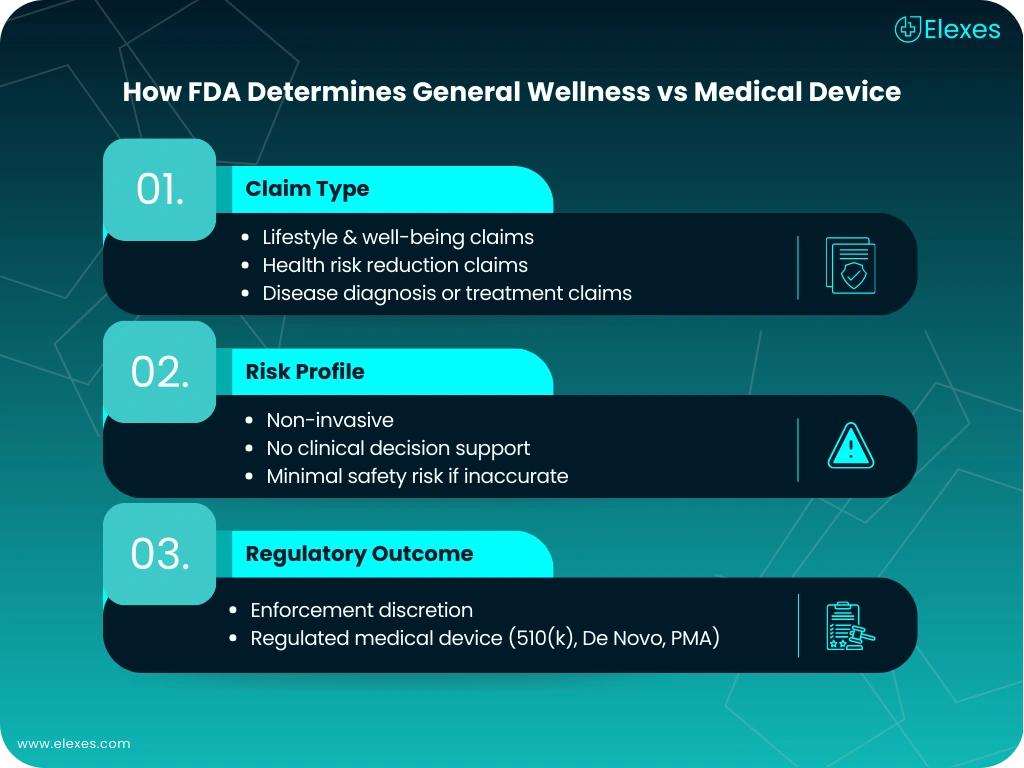
FDA places general wellness claims into two categories:
1. Lifestyle & Well-Being Claims
Claims linked to physical activity, sleep, relaxation, or mental sharpness without mentioning diseases.
2. Health Risk Reduction Claims
Claims that describe a general association between a healthy lifestyle and reduced risk of certain chronic conditions, without measuring, diagnosing, or treating the condition.
Regulatory risk increases significantly when claims blur the line between wellness support and medical benefit.
“Low Risk” – How FDA Evaluates It
Low risk is not about innovation level; it is about safety profile. FDA evaluates whether the product:
⦿ Is non-invasive
⦿ Does not pose a significant risk to user safety
⦿ Does not provide treatment recommendations
This is particularly relevant for health wearable devices and wellness-focused digital products/devices.
What Is Still a Medical Device
If a product claims to diagnose, treat, mitigate, or prevent disease; or interprets physiological data for clinical decision-making it is not a general wellness product.
This distinction is central to the ongoing debate of wellness device vs medical device, and FDA will assess claims, labeling, and marketing holistically.
Enforcement Discretion ≠ Exemption
A common misconception is that enforcement discretion means “FDA-free.” It does not. Products must still comply with:
⦿ Truthful and non-misleading claims
⦿ General safety and consumer protection laws
⦿ Other applicable regulatory frameworks (FTC, state laws)
Marketing & Claims: The Real Regulatory Risk
For health and wellness applications, compliance risks are often related to the use of marketing language. Web page text, app store descriptions, investor presentations, and even testimonials can change the intended use of the product.
Impact on Product Strategy & Development
Product teams have to mix up like regulatory, clinical, and marketing strategies very early on. Changes in claims in the late stage of development commonly result in costly remediation or reclassification.
What RA/QA Teams Should Do Now
⦿ Perform a claim-based regulatory assessment
⦿ Re-evaluate product classification assumptions
⦿ Align design controls where future medical claims are anticipated
⦿ Prepare scalability plans in case future product changes trigger a shift in regulatory status.
Regulatory Watchpoints & Common Mistakes
⦿ Disease-adjacent language without clearance
⦿ Over-interpreting physiological data
⦿ Assuming wellness status is permanent
⦿ Ignoring international regulatory alignment (EU MDR, Health Canada)
How Elexes Can Help
Elexes supports organizations in evaluating whether their wellness applications and connected devices fall under FDA enforcement discretion or require formal regulatory pathways. Our specialists help to review claims, strategize FDA submissions, align with ISO 13485, and plan global market access.
👉 Learn more about our FDA Submission Services, ISO 13485 Consulting, and CE Marking Services.
If you are developing or scaling health and wellness products and need clarity on FDA classification and compliance strategy, contact Elexes today to ensure your innovation stays compliant while reaching the market faster.
Click here to read more about the news.
FAQs
-
What are health and wellness products under FDA guidance?
Health and wellness products support general well-being or lifestyle improvement and do not diagnose, treat, or prevent disease. FDA may apply enforcement discretion if the product is low risk.
-
How does FDA define wellness device vs medical device?
FDA looks at intended use and claims. If a product makes disease-related or clinical claims, it is regulated as a medical device - even if marketed as a wellness product.
-
Are health wearable devices regulated by the FDA?
Some health wearable devices fall under enforcement discretion, but only if they make general wellness claims and pose low safety risk. Devices with medical claims require FDA clearance.
-
How should companies respond to this FDA guidance?
Companies should review product claims, confirm classification, and align regulatory strategy early, especially if future medical claims or market expansion is planned.