
MEMS Packaging, Hermetic Sealing Reliability, and Outgassing Effects in Pressure Sensors
Introduction to MEMS Pressure Sensor Reliability
Micro-electro-mechanical systems (MEMS) pressure sensors are integral to medical devices, industrial automation, and aerospace systems. The above-mentioned factors are not only influenced by the microfabrication and transduction physics, but also by difficult packaging interactions, the integrity of hermetic seals, and the behavior of gases trapped within the sealed reference cavity, including pressure stability and chemical interactions. The significance of these factors is heightened during the transition of sterilization cycles and in the case of continuous application in tough settings.
The Critical Role of Packaging and Hermetic Sealing in MEMS Sensors
In the design of MEMS devices, packaging is not an afterthought. In contrast to standard integrated circuits, MEMS pressure sensors directly interact with external media through diaphragms or pressure ports, making packaging a functional part of the sensing system rather than a passive enclosure. The outcome of the research indicates that not only the package is the one with the strongest influence on performance, lifespan, and failure modes.
Why Hermetic Sealing Matters
High-quality hermetic sealing plays a critical role in extending device longevity by limiting moisture ingress, contamination, and internal pressure instability. In medical, aerospace, and high-reliability systems where a “true” airtight barrier is required, hermetic integrity becomes vital to the prevention of corrosion or drift.
Hermetic sealing also stabilizes internal cavity pressure, which is vital for absolute sensors that reference an internal vacuum or controlled atmosphere. Degradation of this seal over time leads to performance shifts and can accelerate failure mechanisms.
How Outgassing Impacts MEMS Performance
Even with effective hermetic sealing, the internal environment of MEMS pressure sensors can change over time due to outgassing. Materials within the package can release trapped or adsorbed gases, leading to gradual increases in cavity pressure. This alters sensor damping, reference conditions, and calibration stability, particularly in absolute and resonant pressure sensors.
What Causes Outgassing?
Materials within the package, such as die-attach adhesives, polymeric coatings, passivation layers, thin films, and residual surface contaminants, can retain absorbed gases that are released over time or during thermal exposure.
Failures Under Sterilization and Long-Term Use
The deployment of medical sensors necessitates the application of sterilization methods (steam autoclave, gamma radiation, ethylene oxide). Such extreme conditions are a real test for MEMS packaging and can eventually lead to shifts in sensor responses that are detectable. Published studies comparing sterilization methods have shown measurable output drift in MEMS pressure sensors. In steam sterilization cycles, shifts on the order of ±0.2 to ±0.3 mV have been reported, commonly attributed to oxide growth, moisture interaction, and stress redistribution within the sensor structure.
Thermo-Mechanical Stress and Micro-Crack Initiation
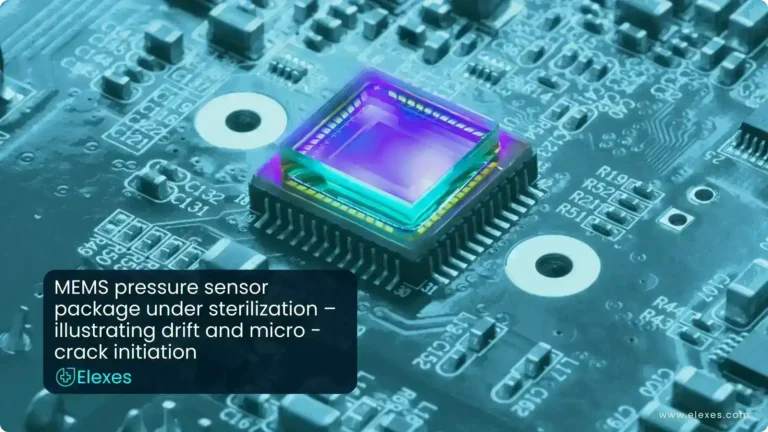
Thermal cycling helps to develop a mismatch in thermal expansion between the MEMS chip, package lid, die-attach materials, and compound encapsulants. In the long run, these mismatches can create micro-cracks that affect the seals and allow the ingress of humidity or gases into the cavity. Once initiated, these micro-cracks can propagate toward sealing interfaces, ultimately compromising hermetic integrity and accelerating long-term drift or failure.
Common Failure Mode Patterns in MEMS Pressure Sensors
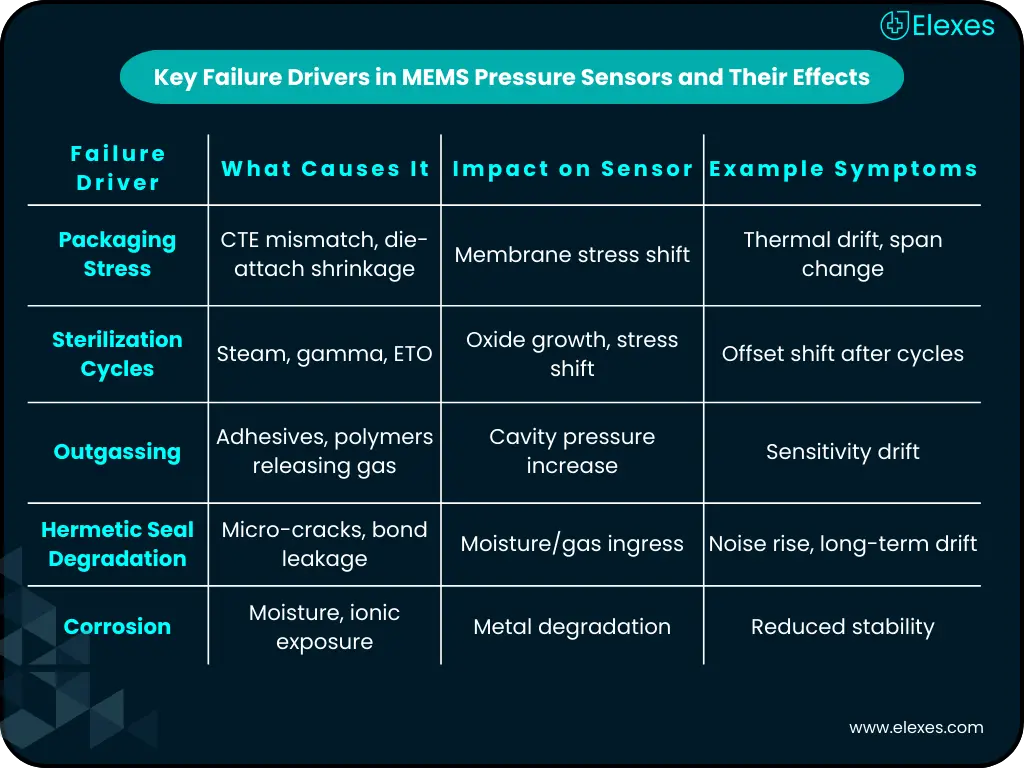
Here are documented failure trends seen in practice and confirmed by studies on MEMS packaging reliability:
Drift in Zero Offset and Span
Sterilization cycles and long-term exposure change material properties and stress profiles, leading to offset and span drift.
Cavity Pressure Changes
The gradual release of gases leads to an increase in the internal pressure, which in turn changes the baseline of the sensor reference and its damping characteristics.
Seal Degradation
Thermal cycling, humidity, and mechanical load reduce hermetic integrity over time.
Corrosion and Material Degradation
Corrosion of metal layers, bond pads, or interconnects, particularly in biomedical environments, can increase electrical leakage, elevate noise levels, and contribute to sensitivity loss and long-term drift.
Collectively, these failure patterns underscore the importance of robust MEMS packaging, controlled outgassing, and durable hermetic sealing for long life and measurement reliability.
Best Practices to Mitigate Failure Modes
Engineers have a way of greatly enhancing the performance of the sensors over a long period of time by:
Matching Coefficients of Thermal Expansion
Select packaging materials with similar CTE values to reduce induced stress.
Optimizing Hermetic Sealing Techniques
Use glass–silicon anodic bonds, ceramic packages, or metallurgical seals that maximize barrier quality.
Controlled Outgassing Protocols
Pre-bake materials and use internal getters to absorb desorbed gases and stabilize the internal environment.
Rigorous Sterilization Testing
Validate sensors under actual sterilization cycles (e.g., steam, gamma, ETO) and measure pre/post drift.
Inspect for Micro-Cracks
Use tools such as scanning acoustic microscopy or SEM to identify early micro-crack formation.
Conclusion
Designing MEMS pressure sensors for sterilizable or long-life applications requires careful attention to packaging design, hermetic sealing reliability, and internal gas control. A clear understanding of these interacting mechanisms helps engineers reduce drift, manage failure risks, and extend sensor service life in demanding environments.
If you would like to explore regulatory guidance or consulting services related to MEMS sensor reliability, please contact us at Elexes.