
FDA ASCA Program: Reducing Review Uncertainty Through Trusted Testing Standards
Introduction
It is not uncommon for the FDA reviews to be significantly delayed due to the questioning of the testing results rather than the absence of certain data. To address this challenge, the U.S. Food and Drug Administration’s Accreditation Scheme for Conformity Assessment (ASCA) plays a growing role in improving the predictability and reliability of standards-based testing used in medical device submissions.
The FDA continues to refine ASCA to ensure that test data supporting regulatory decisions are generated consistently, transparently, and with a high level of confidence. Recent program updates further highlight the importance of early regulatory strategy and informed laboratory selection when using consensus standards in FDA submissions.
👉 Official reference: click here.
What Is ASCA and Why Predictability Matters
Through ASCA, the FDA can consider test results produced by different competent laboratories that have been accredited for their ability to perform testing according to FDA-recognized consensus standards. If the test reports fulfill the ASCA requirements, then the FDA reviewers would trust the data to a larger extent, which would consequently result in a reduced need for follow-up questions or requests for clarification.
Predictability is critical for manufacturers preparing submissions such as FDA 510(k), De Novo, or PMA applications. When testing expectations are clear, and data is generated in alignment with FDA-recognized standards, review risk is significantly reduced.
Strengthening Confidence in Standards-Based Testing
One of ASCA’s core goals is to improve confidence in how standards are applied, not just which standards are used. The FDA reviews the labs that have received accreditation to ensure that the testing is done in a professional manner, that all steps are traceable, and that the requirements of the ASCA program are adhered to.
Recent ASCA updates reinforce that:
⦿ Accreditation status must remain valid throughout testing
⦿ Test data integrity is essential for FDA reliance
⦿ Only compliant ASCA summary test reports are accepted in submissions
These measures help prevent scenarios where manufacturers must repeat testing due to lab or documentation concerns—saving both time and resources.
The Role of Early Regulatory Strategy
ASCA delivers the greatest value when it is integrated early in the regulatory planning phase, not added after testing has already begun. Some major strategic decisions are:
⦿ Deciding on the FDA-recognized consensus standards that best fit the device
⦿ Checking the testing laboratory’s ASCA scope and accreditation status
⦿ Creating test plans that match submission pathways and regulatory expectations
Making the technical and regulatory alignment early reduces the probability of the FDA having questions, the data being incomplete, or there being unexpected rework during the evaluation.
How ASCA Benefits Medical Device Manufacturers
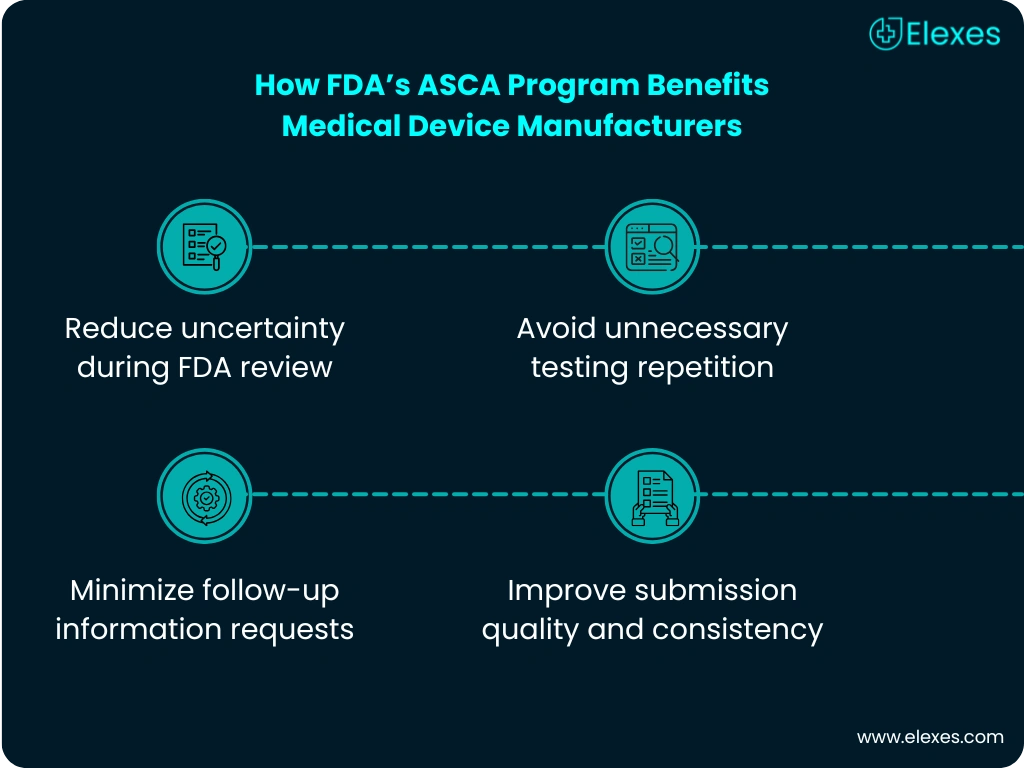
ASCA, by enhancing the predictability of conformance assessment, helps manufacturers to:
⦿ Reduce uncertainty during FDA review
⦿ Avoid unnecessary testing repetition
⦿ Minimize follow-up information requests
⦿ Improve submission quality and consistency
When combined with strong quality management systems such as ISO 13485, ASCA supports a more robust regulatory foundation for U.S. and global market access, including CE Marking and other international pathways.
How Elexes Supports ASCA-Aligned Submissions

Elexes collaborates with the makers of medical devices to integrate ASCA into their complete regulatory approach. The collaboration of our teams involves the following:
⦿ Standards selection and regulatory gap analysis
⦿ FDA premarket submission planning
⦿ Quality system alignment with ISO 13485 requirements
⦿ Coordination with accredited testing laboratories
By early testing strategy alignment, we help companies minimize regulatory risk and also progress through FDA review with more assurance.
Conclusion
The FDA’s ASCA program is more than an accreditation framework - it is a tool for building trust, consistency, and predictability into medical device submissions. Manufacturers who engage early, select their labs with care, and synchronize their testing with FDA expectations will be in a stronger position to prevent delays and manage review smoothly.
👉 Do you want to strengthen your FDA submission strategy?
Get in touch with Elexes to find out how we can assist with ASCA-aligned testing and regulatory planning.