
Understanding Health Canada’s Expectations for Diagnostic Ultrasound Device Licensing
Canada continues to be a strategic market for manufacturers of diagnostic imaging technologies. The latest Notice to Industry clarifies Health Canada’s expectations and common deficiencies observed in device licence applications requirements for diagnostic ultrasound systems and transducers. The new requirements establish precise documentation standards and performance evidence requirements, and pathways for regulatory understanding.
The update affects manufacturers who need to submit new applications or amendments, or expand their market, because it defines how Health Canada medical device regulations assess intended use, system configuration, and safety data.
Why This Guidance Matters for Ultrasound Device Manufacturers?

People in Canada need to obtain a Medical Device Licence (MDL) to commercially distribute diagnostic ultrasound devices because these devices operate as controlled medical equipment. Health Canada issued the new announcement to clarify the regulatory standards and common deficiencies found in license applications to help streamline the review process. The guidance strengthens compliance because it provides better alignment with medical device regulations while showing how clinical use relates to system components and supporting evidence.
Key Regulatory Expectations Highlighted in the Notice
1. Clear Definition of Intended Use
The manufacturers need to establish an intended use statement that maintains both precise language and technical documentation backing all aspects of its content.
This includes:
⦿ Clinical purpose and target population
⦿ Anatomical sites and imaging modes
⦿ User environment (hospital, clinic, point-of-care)
Any ambiguity in the intended use may trigger information requests, review delays, or reassessment of the device classification.
2. System-Level and Transducer-Specific Evidence
Health Canada mandates that ultrasound systems and transducers must undergo assessment as both separate units and combined system components.
Submissions should clearly describe:
⦿ Compatibility between systems and transducers
⦿ Acoustic output parameters
⦿ Risk controls addressing thermal and mechanical indices
The medical device industry requires strong regulatory compliance, which needs special attention in cases that involve modular device setups.
3. Alignment with Quality and Safety Standards
The applicants need to prove their compliance with established international standards which include both IEC standards and ISO standards that apply to ultrasound technology.
While not specific to this notice, alignment with ISO 13485 supports robust documentation, change control, and post-market oversight expected by Health Canada
Practical Implications for Device Licence Applications
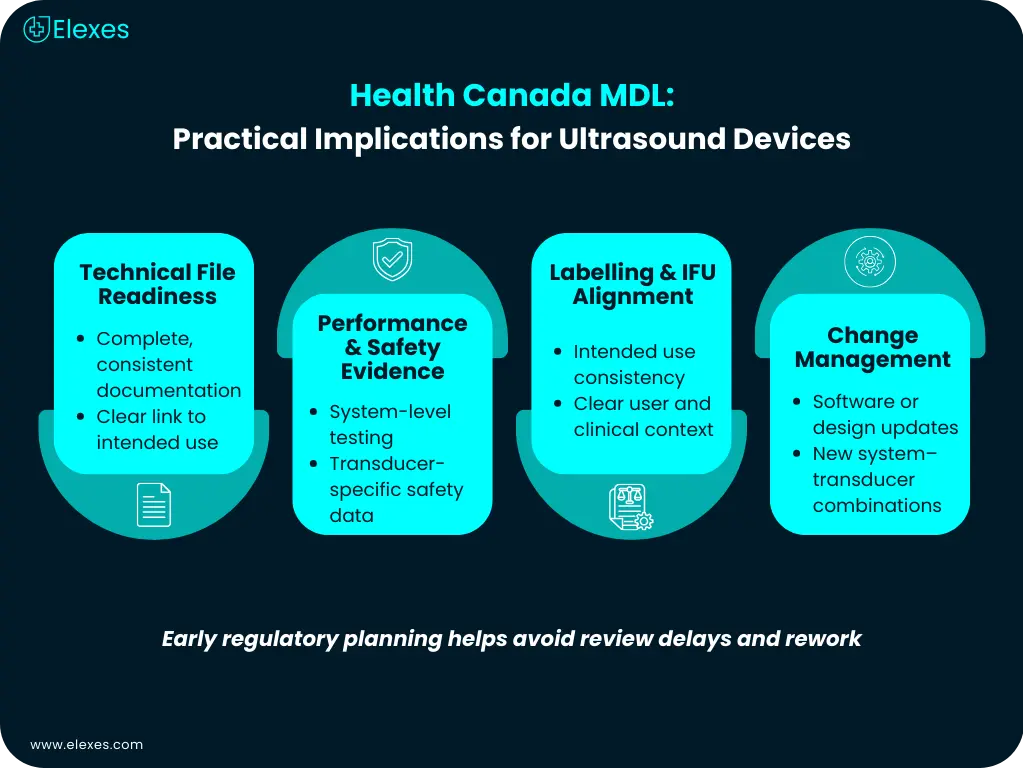
Manufacturers who want to enter the Canadian market or change their licences should expect a more detailed regulatory review of:
⦿ Technical file completeness
⦿ Performance and safety validation
⦿ Labelling and instructions for use
⦿ Change management affecting licensed configurations
Medical device regulations in Canada can achieve better outcomes through effective early regulatory planning because it decreases review times while preventing expensive resubmission processes.
How Elexes Supports Ultrasound Device Manufacturers
Elexes provides manufacturers with complete support for regulatory compliance throughout their medical device compliance process, which includes Canadian MDL planning and gap analysis, and submission assistance.
Our team develops compliance documents that meet regulatory standards while preparing clients for audits by combining Canadian standards with other international requirements, like FDA, CE Marking, TGA, etc.
Planning a diagnostic ultrasound device licence application or amendment in Canada?
Contact Elexes to ensure your submission aligns with Health Canada’s latest expectations and avoids preventable delays.
👉 Get in touch with our regulatory experts today.
To read the official Health Canada notice to industry, click here.
FAQs
Are ultrasound transducers licensed separately in Canada?
Yes. The licence application needs transducers to produce their own identification and compatibility data and safety information, although they are assessed together with the system.
Does a CE-marked or FDA-cleared ultrasound device automatically qualify in Canada?
No. While helpful, prior approvals do not replace Canadian requirements under Health Canada’s regulatory framework.
How critical is the intended use statement in an MDL application?
It is essential. Intended use directly affects the three components, which include classification and evidence requirements and license boundaries.
Do software updates to ultrasound systems require licence amendments?
Potentially yes, especially if updates impact performance, safety, or clinical use.
How can manufacturers reduce Health Canada review delays?
By ensuring complete documentation, clear system descriptions, and alignment with applicable standards from the outset.