









ISO 13485 Design and Development

Cross-functional medical device team holding an ISO 13485 design review around a prototype, engineering drawings and a traceability matrix

ISO 13485 design and development is clause 7.3 of ISO 13485:2016, which controls how a medical device moves from approved requirements to a verified, validated design.

FDA's Quality Management System Regulation (QMSR), effective February 2, 2026, incorporates ISO 13485:2016 by reference, making clause 7.3 the common basis for medical device design and development evidence across the US, EU, UK, Canada and Australia, from feasibility exit to every post-launch change.

What ISO 13485 Clause 7.3 Requires

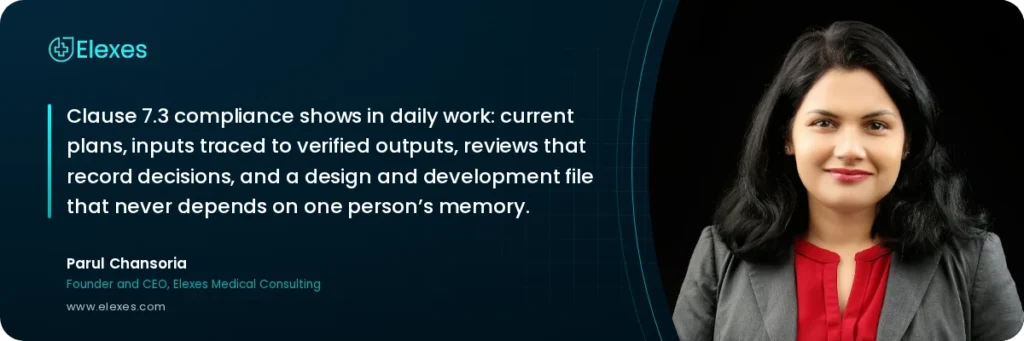
Parul Chansoria, Founder and CEO of Elexes, on what ISO 13485 clause 7.3 design and development compliance looks like in daily work

ISO 13485 Design and Development Plan and Inputs (7.3.1–7.3.3)

You need documented procedures and a plan defining stages, reviews, verification, validation, transfer, responsibilities, traceability and resources. Inputs cover functional, performance, usability, safety and regulatory requirements, standards and risk management outputs, and must be approved, unambiguous and verifiable.

Outputs, Reviews, Verification and Validation (7.3.4–7.3.7)

Outputs must be verifiable, include acceptance criteria and support production. Reviews at planned stages involve the relevant functions and record decisions. Verification shows outputs meet inputs; validation shows the device meets its intended use on representative product, with sample-size rationale and clinical or performance evaluation where required.

Transfer, Changes and the File (7.3.8–7.3.10)

Transfer is proof that the product’s outputs can be used successfully in manufacturing prior to being implemented as production specifications. The impact of changes is determined on functionality, performance, usability, safety, compliance, and risk; then, reviewed, verified, or validated depending on the need, and approved prior to implementation. Each device requires a design and development file with its conformity documentation.

The Medical Device Design and Development Process in Your QMS

Clause 7.3 lives in your ISO 13485 quality management system as an SOP, stage-gate templates, a living traceability matrix and links to risk management, document control and training. Specification developers keep design responsibility when outsourcing manufacturing, so quality agreements should define transfer and change duties.

Roles and Routine Checks

R&D owns the plan and outputs, QA controls records, RA sets regulatory inputs and assesses changes, and manufacturing joins before transfer. Routine checks cover stage-gate reviews, traceability updates, change impact assessments, internal audits of clause 7.3, post-market feedback into inputs and CAPA for systemic gaps.

Compliant on Paper vs Working in Practice

Regulatory consultant and engineer reviewing a medical device design and development file with verification reports

Documents may appear compliant but will fail inspection, particularly if only one engineer understands the document. How strong and paper-only systems differ:

⦿ Planning: updated as work evolves, not written once and never revised.

⦿ Traceability: links design inputs, outputs, risk controls, and verification and validation evidence throughout development, rather than reconstructing these connections before submission.

⦿ Reviews: decisions and closed actions, not attendance lists.

⦿ Verification and validation: approved protocols, defined acceptance criteria, representative test conditions, and documented results demonstrating conformity with design requirements and intended use.

⦿ Changes: documented assessments of impacts on device performance, safety, risk controls, V&V evidence, and regulatory requirements before implementing design changes.

⦿ Design and development file: indexed, current and audit-ready, not scattered across drives.

Recent FDA Finding: In October 2026, the FDA identified missing design traceability matrices and incomplete design verification following changes to certain devices. These findings reinforce the importance of maintaining complete, traceable design evidence throughout the device lifecycle.

Beyond Compliance: What a Strong System Gives You

In a working system, understanding product knowledge becomes dependent on the process itself, not on the individual involved. The new engineers learn through a documented rationale, and changes in the team have less impact while the best R&D personnel can concentrate on design and not reconstruction, making it easier for you to recruit and retain such people. Evidence-based decisions improve the products and create customer loyalty.

Medical Device Design and Development Expectations by Market

In accordance with the QMSR, clause 7.3 is applicable to Class II, Class III, and some Class I devices, and 510(k), De Novo and PMA submissions use their verification and validation information. Technical documentation according to the EU MDR should contain information about design and test, Health Canada needs to have MDSAP certification for Class II-IV licenses, and MHRA & TGA require controlled design and development under QMS.

Standards have procedures: ISO 14971 on risk, IEC 62304 on medical device software, IEC 60601-1 on medical electrical devices, IEC 62366-1 on usability and ISO 10993-1 on biocompatibility. They are normally voluntary, but usually it is through the recognized or harmonized versions that conformance is achieved.

How Elexes Supports ISO 13485 Design and Development

Elexes works with your engineers to build or strengthen design and development files your team owns, built for FDA, notified body, MHRA, Health Canada and TGA review. We assess what exists, recommend a strategy, prepare records and keep them current through transfer and later changes.

Retrospective vs Prospective Documentation

The retrospective study is based on the information that you have; the prospective study is done on the documents created when the development process occurs, by Elexes.

Retrospective Documentation

⦿ Most useful for: products that are on the market or almost ready for marketing, whose documentation is sparse

⦿ Strength: leverages your existing data

⦿ Weakness: omissions require additional testing; documents always show true dates, no backdating

Prospective Documentation

⦿ Most useful for: newly developed products or significantly redesigned products

⦿ Strength: built-in traceability

⦿ Weakness: requires early involvement and regular maintenance

Our Medical Device Design and Development Services

Design and Development Documentation Remediation

Updating files after standards, regulations or the design change.

First-Time Design and Development Documentation

Procedures, templates, plans and traceability for teams building their first QMS.

Retrospective Design and Development Documentation

A compliant file built from your existing evidence.

Design Controls & Traceability Assessment

Review design requirements, risk controls, V&V evidence, and change records to identify traceability gaps and documentation deficiencies.

Assess Your ISO 13485 Design and Development Readiness

Use our checklist to find gaps in your clause 7.3 process and file before an auditor does.

FAQs

Frequently Asked Questions!

Since February 2, 2026, US design requirements have come from ISO 13485 clause 7.3, replacing the former 21 CFR 820.30 design controls. Design history file records now belong in the design and development file.

Yes, however existing documentation may constitute an acceptable file, but recreated documents should reflect their proper date, and lack of verification/validation may require further testing.

Only if they perform design and development. Where regulations allow design exclusions, the specification developer or legal manufacturer must keep a complete design and development file.

Our Compliance Assessment Process

Our process begins with an in-depth consultation where we learn about your medical device, its intended use, and your specific goals. This helps us tailor our assessment to your unique needs.

Our team of experts is well-versed in global medical device regulations, including FDA submissions, CE marking, TGA requirement, Health Canada approvals, ISO, and more. We stay up-to-date with the latest changes in the regulatory landscape.

img
img

We will conduct a comprehensive review of your existing documentation, including design files, clinical data, quality management systems, and risk assessments.

Our consultants will perform a gap analysis to identify any areas where your device may fall short of compliance. This forms the basis for our recommendations.

Based on our findings, we will provide you with detailed recommendations and a roadmap for achieving compliance. This may involve revising documentation, conducting additional testing, or making necessary design changes.

Our services don't stop with just the assessment. We offer ongoing support to guide you through the compliance process, helping you address any challenges that may arise.

A Trusted Team of Consultants

Elexes offers a globally recognized ISO 13485 certification consultant who is renowned to enhancing your business credibility in the medical devices industry.

Local Language
Auditor

Our presence across the globe ensures audits are conducted by local-language auditors, facilitating clear communication and understanding.

Why Choose Elexes?

Expertise

Our experts provide guidance and consultants to help you adhere to necessary regulations, ensuring your products meet all legal requirements and is compliant to all necessary standards.

Local Regulatory Certification

At Elexes, we offer to assist in securing additional local certifications, enabling you to manufacture and sell medical devices in various markets across the globe.

Confidentiality

We offer complete confidentiality to all our clients which makes us one of the most trusted regulatory and quality compliance consulting.

Associated Regulatory Authorities.

img
We’ve More
Than 256+ Global Clients
The Best RA & QA Consultants
Clients Testimonials

Amazing Feedback About Our Services

Popular Clients

We’ve 200+ Global Premium Clients

Saneso
Niramai
Apex dental sensors
Neurasignal
SS inovations
Amaryllis
Inclode
iMedisync
DJOGlobal logo cmyk_TM
Summus Laser Logo
Looking For Regulatory Assistance?

Let's Talk How We Can Help You?

Please enable JavaScript in your browser to complete this form.
Name
img
Please enable JavaScript in your browser to complete this form.
Name
img
Please enable JavaScript in your browser to complete this form.
Name
img
Please enable JavaScript in your browser to complete this form.
Name
img
Please enable JavaScript in your browser to complete this form.
Name
img