

Getting Ready for UDI Compliance in Australia: A Guide for Medical Device Manufacturers
Introduction
Australia's rules for medical devices keep shifting, with a big focus now on tracking them properly and ensuring safety after they're out in the market. The Therapeutic Goods Administration (TGA) has published updated guidance titled “Complying with the Unique Device Identification requirements for medical devices” to help manufacturers and sponsors understand how to supply Unique Device Identification (UDI) compliant medical devices in Australia.
The guidelines outline how medical device companies must comply with Unique Device Identification labeling and device data submissions to the AusUDID (Australian Unique Device Identification Database). This is a critical part of TGA medical device regulations.
For manufacturers planning to enter the Australian market, understanding UDI TGA obligations is now essential.
What Is Unique Device Identification?
One of the most common questions manufacturers ask is: What is Unique Device Identification (UDI) for medical devices?
Unique Device Identification is a globally recognized system that assigns a unique code to every medical device model and packaging configuration. The identifier helps regulators, healthcare providers, and manufacturers track devices throughout their lifecycle.
In Australia, the UDI system requires two key elements:
⦿ A UDI carrier placed on device labeling or packaging
⦿ Submission of device data to the AusUDID
This system supports product identification, post-market surveillance, and more efficient safety alerts and recalls.
The UDI framework in Australia was introduced through amendments to the Therapeutic Goods (Medical Devices) Regulations 2002, establishing requirements for device identification and submission of device data to the Australian UDI Database (AusUDID).
Why UDI Compliance Matters Under TGA Medical Device Regulations
UDI implementation is becoming a central part of TGA medical device regulations and has direct implications for manufacturers and sponsors supplying devices in Australia.
Key benefits of the UDI framework include:
⦿ Improved traceability of devices across the supply chain
⦿ Faster and more accurate recall processes
⦿ Better post-market safety monitoring
⦿ Greater transparency for healthcare providers and patients
Because of these benefits, regulators worldwide, including Australia, the United States, and the European Union, are increasingly adopting UDI-based regulatory systems.
UDI Requirements for Medical Device Manufacturers in Australia

Manufacturers and sponsors often ask: Do medical devices need UDI in Australia?
UDI requirements are being implemented in Australia through a phased regulatory framework, meaning many devices supplied in Australia will be required to comply, depending on their classification and applicable compliance timelines.
Companies must:
⦿ Assign a UDI to the device using a recognized issuing agency
⦿ Apply the UDI carrier to device labeling and packaging
⦿ Submit device identification data to the AusUDID
⦿ Maintain accurate records and update the database when changes occur
Most manufacturers are responsible for generating the UDI identifier during the manufacturing process, while sponsors ensure regulatory compliance in Australia.
These requirements are also closely tied to TGA medical device labeling requirements, which define how device information must appear on labels and packaging.
Who Must Submit Data to the Australian UDI Database (AusUDID)?
Another frequent question is: Who must submit data to the Australian UDI database (AusUDID)?
The AusUDID stores the UDI device identifier and related product information for devices supplied in Australia. The database links device data with entries in the Australian Register of Therapeutic Goods (ARTG).
Responsibilities are shared between manufacturers and sponsors:
⦿ Sponsors are legally responsible for ensuring UDI data is submitted and maintained in the AusUDID, although manufacturers typically generate the UDI identifier and provide the required device data.
⦿ Manufacturers may submit device data, but sponsors must link the device to the ARTG entry.
Once linked to the ARTG, the UDI record becomes publicly available in the AusUDID, allowing healthcare professionals and regulators to access device information.
How to Comply with UDI Requirements in Australia
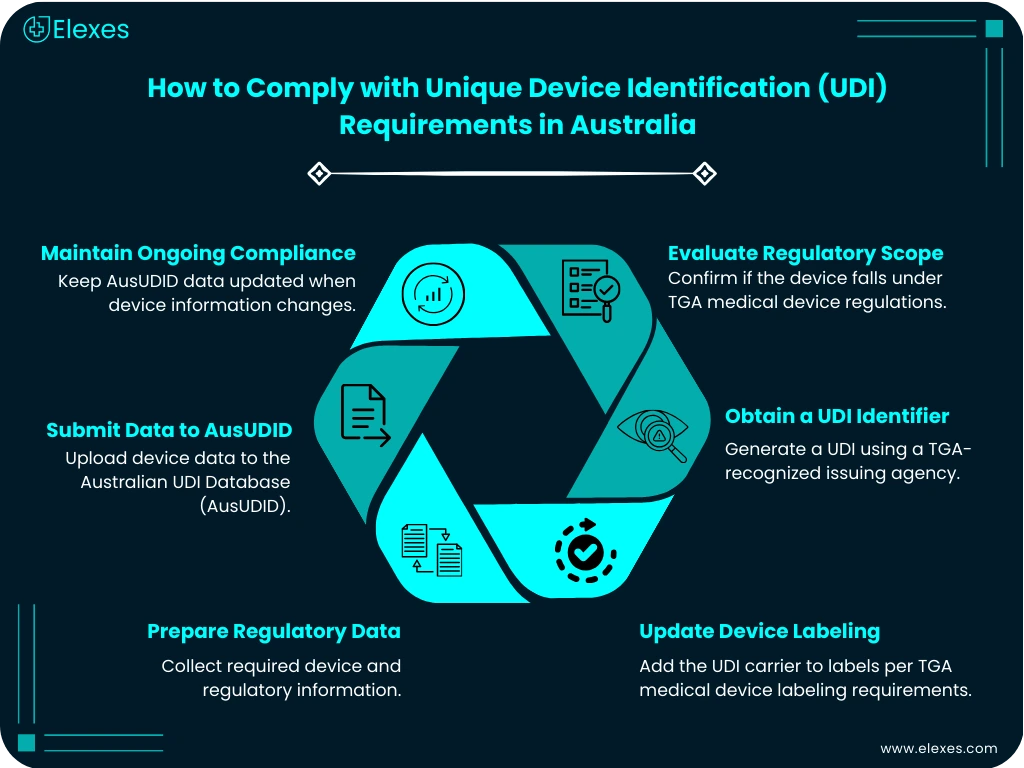
Companies entering the Australian market often ask this question. The practical approach to comply with UDI requirements in Australia includes these key steps:
1. Evaluate regulatory scope
Determine whether the device falls within the UDI framework under TGA medical device regulations.
2. Obtain a UDI identifier
Use a TGA-recognized issuing agency to generate the UDI device identifier.
3. Update device labeling
Ensure device labels meet TGA medical device labeling requirements and include the UDI carrier.
4. Prepare regulatory data
Compile required device attributes and regulatory data.
5. Submit device data to the AusUDID
Upload UDI records and link them to the ARTG entry.
6. Maintain ongoing compliance
Update the database whenever device information changes.
Taking a structured approach helps companies avoid regulatory delays when supplying devices in Australia.
How Elexes Supports UDI Implementation
UDI implementation often requires coordination between regulatory teams, labeling engineers, and supply chain systems.
Elexes helps medical device manufacturers develop regulatory strategies for implementing Unique Device Identification requirements in Australia. Our support includes:
⦿ UDI regulatory strategy aligned with TGA medical device regulations
⦿ Device labeling review aligned with TGA medical device labeling requirements
⦿ Preparation of AusUDID device data submissions
⦿ Alignment of UDI records with ARTG regulatory documentation
⦿ Integration of UDI implementation into broader global regulatory strategies
Do Medical Devices Need UDI in Australia?
Many manufacturers ask whether Unique Device Identification requirements apply to their products. Under TGA medical device regulations, UDI compliance will apply to most regulated medical devices supplied in Australia as the phased implementation progresses. Manufacturers and sponsors must ensure devices are properly identified, labeled with a UDI carrier, and linked to the Australian UDI Database (AusUDID).
Read the official TGA guidance here
FAQs
What is a Unique Device Identification (UDI) for medical devices?
A Unique Device Identification (UDI) is a system used to give every medical device a specific identification code. This code helps identify the device model and details about its production, such as the manufacturer, lot number, or serial number.
Do medical devices need UDI in Australia?
Yes. Devices supplied in Australia must comply with UDI TGA requirements, which include placing a UDI carrier on labeling and submitting device information to the AusUDID database in accordance with TGA medical device regulations.
Who must submit data to the Australian UDI Database (AusUDID)?
Sponsors are legally responsible for submitting and maintaining UDI records in the AusUDID. Manufacturers may provide device information or submit data on behalf of the sponsor, but the sponsor must link the device record to the ARTG entry to meet regulatory obligations.
What information must be submitted to the AusUDID?
The AusUDID requires the device identifier (UDI-DI) along with related product information such as manufacturer details, device characteristics, packaging levels, and regulatory data linked to the ARTG inclusion.
How can manufacturers comply with UDI requirements in Australia?
Companies should evaluate device scope, obtain UDI from a TGA-recognized issuing agency, update device labels according to TGA medical device labeling requirements, and submit device data to AusUDID.