A Comprehensive Guide to Photoacoustic Imaging and Tissue-Mimicking Phantoms
Why Phantoms Are Essential in Validation Studies
In medical imaging research, Phantoms play a pivotal role as controlled, well-characterized test objects used for validating imaging systems before clinical use. These engineered structures mimic the mechanical, acoustic, and optical behavior of biological tissues. Because they significantly reduce biological variability such as patient motion, physiological fluctuations and ethical constraints, phantoms have become central to method papers, imaging device development studies and quality assurance programs. While Phantoms significantly reduce biological variability, minor variability may still arise from fabrication tolerances and material aging, which should be controlled through standardized preparation and storage protocols.
Material Composition in Phantom Development
The choice of the basic material is the key to the birth of a scientifically sound Phantom. The matrix should not only resemble the real tissue but also imitate its density, acoustic impedance, speed of sound, scattering, and optical absorption properties. Hydrogels, agarose, polyvinyl alcohol (PVA) cryogels and polyvinyl chloride plastisol (PVCP) are among the most widely used materials for ultrasound, optical, and Photoacoustic imaging applications.
Among others, the use of copolymer-in-oil Phantoms has been supported by studies showing that the speed of sound can be gradually tuned to the value of 1480 m/s around typical diagnostic ultrasound frequencies, which is very close to soft tissue values. Although copolymer-in-oil and PVCP-based Phantoms are particularly advantageous for long-term stability and tunable acoustic properties, agarose and PVA cryogels remain widely used due to their ease of fabrication and established use in ultrasound and Photoacoustic imaging research. When appropriately designed, Phantom materials can closely approximate light–tissue and ultrasound–tissue interactions, enabling accurate, controlled, and reproducible evaluation of imaging system performance.
Acoustic and Optical Property Matching for Photoacoustic imaging
To support multimodal applications such as ultrasound, OCT, multispectral imaging and especially Photoacoustic imaging, Phantoms must match tissue acoustic and optical properties precisely. In Photoacoustic imaging, relevant parameters include the optical absorption coefficient (μₐ), reduced scattering coefficient (μ’ₛ), speed of sound (c), acoustic attenuation (α) and backscatter characteristics. These parameters collectively govern Photoacoustic signal generation, acoustic propagation, and image contrast, making their accurate matching essential for realistic system performance assessment.
Consensus guidelines emphasize the importance of using materials that exhibit tunable absorption and scattering in the near-infrared range commonly used in Photoacoustic imaging. PVCP-based Phantoms, for instance, allow controlled manipulation of optical parameters so the device can be tested across varying tissue-like absorption levels. Accurately matched acoustic and optical parameters ensure that imaging performance metrics—such as depth penetration, spatial resolution, and contrast—closely approximate expected clinical imaging conditions.
Reproducibility Metrics in Phantom-Based Validation
A major advantage of Phantoms is the high reproducibility they offer. Because experimental conditions can be held constant, researchers can collect datasets free from biological variability.
Important metrics that are commonly assessed using Phantoms include:
⦿ Signal-to-noise ratio (SNR)
⦿ Contrast-to-noise ratio (CNR)
⦿ Modulation transfer function (MTF)
⦿ Spatial resolution
⦿ Optical and acoustic attenuation behavior
Research has demonstrated the long-term stability of polymer-based Phantoms, particularly PVA cryogels and PVCP, enabling repeated imaging over extended periods when appropriate storage and handling conditions are maintained. This very same stability gives a chance for the production of so-called benchmark datasets that are both cited and replicated consistently and thus, it leads to the improvement of scientific comparability across different laboratories and detectors including Photoacoustic imaging. Such benchmark Phantom datasets are widely used for inter-laboratory comparison, system calibration, and validation of reconstruction algorithms in Photoacoustic imaging.
Imaging Results Using Phantoms
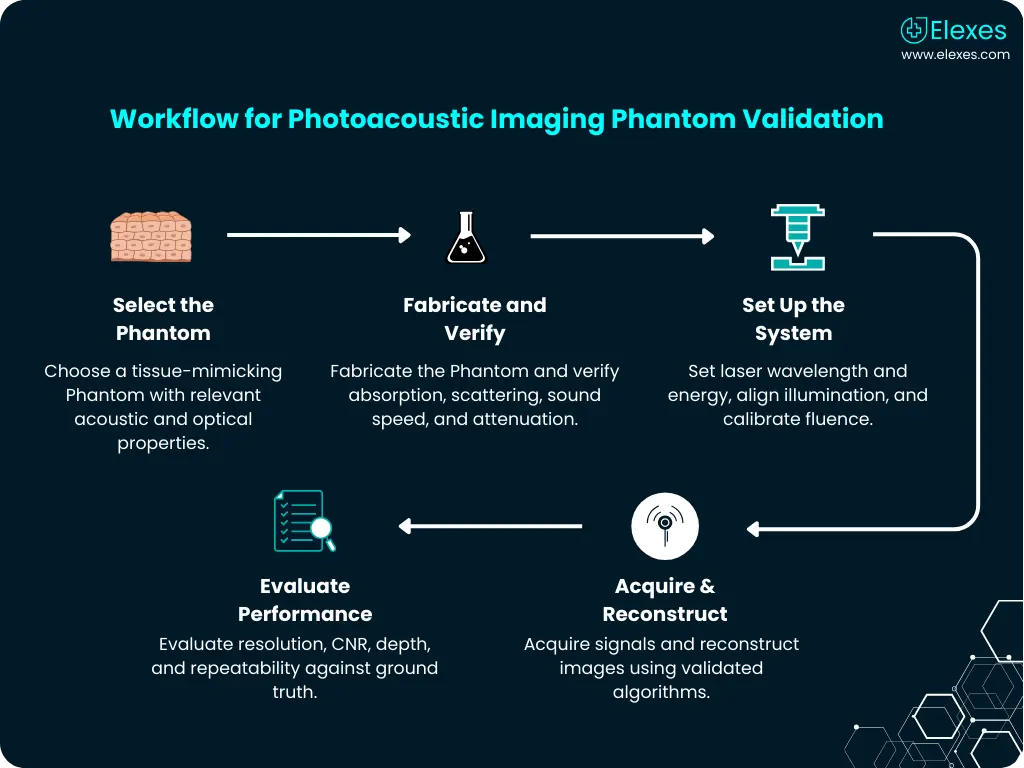
Imaging results obtained from Phantoms serve as both validation data and proof of concept. Whether assessing a new ultrasound probe, a laser excitation protocol in Photoacoustic imaging, or an AI-based image reconstruction method, Phantoms provide known ground truth values such as geometry, layer thickness, optical absorption and scattering coefficients. While Phantom-based results cannot replace clinical evidence, they provide essential preclinical performance verification data required for device development, risk assessment, and regulatory submissions.
Advanced “anatomical Phantoms” imitate blood vessels, stratified skin, retina, or tumor-like inclusions, facilitating the above-mentioned testing through various modes prior to making the trial on animals or humans. This contributes to the safety issue assurance, imaging protocol optimization, and filing for approval where validation datasets are needed.
Conclusion
In summary, Phantoms continue to be essential tools in the development and validation of medical imaging technologies including ultrasound, optical modalities and Photoacoustic imaging. Their controllable, reproducible, and tissue-mimicking characteristics make Phantoms foundational tools for scientific research, device comparison, quality assurance, and generation of preclinical performance evidence supporting regulatory submissions.
If you would like to learn more about our regulatory consulting services, please contact us and we will be happy to support your needs.