

ISO 9001 Quality Objectives: How to Define, Measure & Monitor Them
Quality objectives are important for any organization that seeks to improve quality management system (QMS) & maintain its ISO 9001 certification. Setting and reviewing ISO 9001 Quality Objectives is a core requirement that ensures organizations consistently meet customer requirements, drive continuous improvement, and achieve strategic goals. In this guide, we will discuss –
🔘 What are ISO 9001 quality objectives?
🔘 Does ISO 9001 require quality objectives?
🔘 How to make the quality objectives work for you?
🔘 How many quality objectives should an organisation have?
Elexes has implemented ISO 9001 and ISO 13485-compliant systems for 100+ global MedTech companies. Setting measurable quality objectives can help your team align performance, ensure audit readiness, and drive continuous improvement.
What are ISO 9001 Quality Objectives & Why are they required?
Quality objectives are the standards used by the companies to transform the goal from the quality policy into an actionable plan for improvement. These quality policies are created keeping in mind the customer requirements and are linked to their requirements through the Quality Policy.
In short, Quality objectives of ISO 9001 are goals that are tied to the quality policy of a company. These objectives often measure items that are being identified as most important to the business.
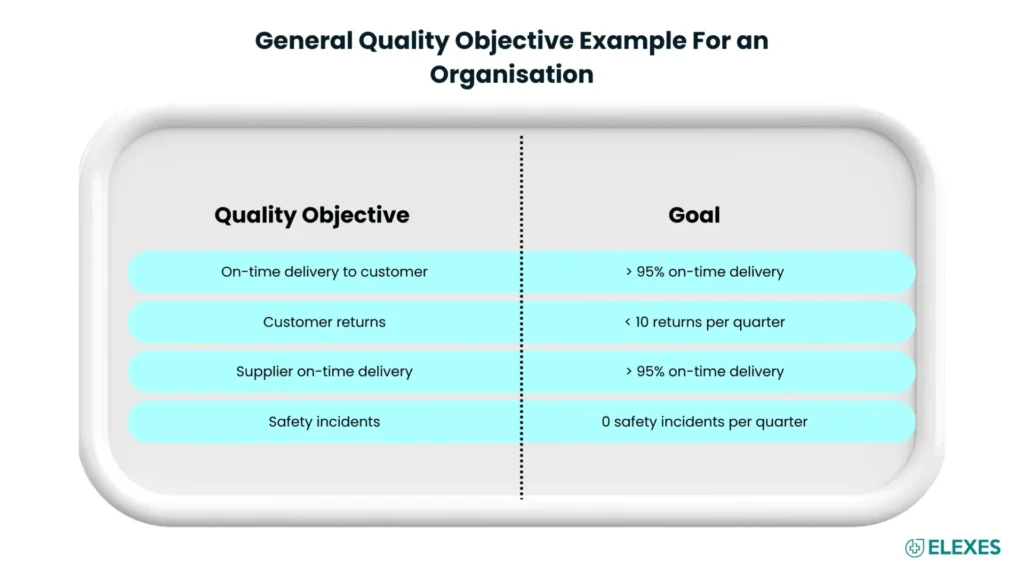
In general these quality objectives include items like delivery, quality, and/or safety.
Does ISO 9001 require quality objectives?
Yes, ISO 9001:2015 requires organizations to establish measurable quality objectives at relevant functions, levels, and processes within their quality management system.
ISO 9001:2026, published in September 2026, is the current edition of the standard, replacing ISO 9001:2015. Organizations should establish quality objectives consistent with their quality policy, applicable requirements, product or service conformity, and customer satisfaction.
Quality objectives need to be measured, communicated, reviewed, and revised as necessary. Moreover, an organization needs to identify the measures required for meeting its quality objectives.
How to make the quality objectives work for you?
Organizations can use the SMART framework to develop effective quality objectives that are Specific, Measurable, Achievable, Relevant, and Time-bound. This approach helps ensure that objectives are practical, aligned with the quality policy, and supported by measurable performance indicators.
Once you have finalised what things you need to monitor, measure and improves, the next thing to do is make the quality objectives effective in addressing what companies should focus on improving.
Companies should design the quality objectives around the concept – S.M.A.R.T (specific, measurable, achievable, realistic, and time-based). They should also make sure that their quality objectives are relevant to all the levels of company which means that each employee must understand how their job supports meeting the quality objectives.

☑️ Specific:
When creating a quality objective, a company must remain very clear and specific. For example: Instead of setting quality objective – “to improve non-conforming product”, you should set a clear and specific objective as – “to reduce non-conformances on the third widget line.”.
☑️ Measurable:
Remember one thing – if you cannot measure an objective, it is nearly impossible to see if the objective is met or not. Therefore, when you are creating a quality objective, make sure that it has to be measurable. For example: If your quality objective is “to improve quality of the products on the third widget line”, it is not as measurable as an objective “to reduce non-conformances on the third widget line from 15% to 5%”.
☑️ Achievable:
Quality objectives should be realistic and achievable considering the organization’s resources, capabilities, and existing performance. Management should ensure that appropriate responsibilities and resources are assigned to support their achievement.
☑️ Relevant:
Quality objectives should align with the organization’s quality policy, applicable requirements, customer expectations, and improvement priorities. For example, reducing production nonconformities may be more relevant than setting an unrelated operational target.
☑️ Time-bound:
Creating a quality objective needs to be time-bound so that it can be clear in heads of the entire organisation to achieve it. For example: Saying “reduce non-conformances on the third widget line from 15% to 5% in the next year” allows team for better planning.
You can also learn how to write good quality objective in our article: Quality Objectives – Driving Improvements.
How many quality objectives should an organisation have?
ISO 9001 does not specify how many quality objectives the organization must have. The organization needs to determine the number of quality objectives, taking into account its size, processes, quality policy, and requirements for improvement.
The objectives should collectively address relevant functions, levels, and processes within the quality management system. The focus should be on meaningful, measurable objectives rather than achieving a particular number.
How often should you review the quality objectives?
Quality objectives should be monitored and reviewed at planned intervals appropriate to the organization’s processes, risks, and performance.
Organizations may review objectives monthly, quarterly, or during management review meetings, depending on their established monitoring arrangements. Additional reviews may be necessary when performance targets are not achieved, significant changes occur, or improvement opportunities are identified.
Need Help Defining Your Quality Objectives?
FAQs
-
What are good examples of ISO 9001 quality objectives?
Examples include 'Reduce customer complaints by 15% within 12 months' or 'Achieve 98% on-time delivery rate in the next quarter.'
-
How often should objectives be reviewed?
ISO 9001 requires organizations to monitor quality objectives and update them as appropriate. The review frequency should be determined based on organizational needs, performance, and established management review arrangements rather than a universally prescribed interval.
-
Can ISO 9001 objectives be qualitative?
ISO 9001 requires quality objectives to be measurable. Objectives may address qualitative aspects of performance, such as customer satisfaction or process improvement, but organizations should establish suitable criteria or indicators to evaluate their achievement.
-
What happens if objectives are not met?
When objectives are not achieved, root cause analysis & appropriate corrective actions should be initiated. This supports continual improvement and compliance with ISO 9001.
-
Is there a standard format for ISO objectives?
While ISO 9001 doesn’t dictate a format, SMART-based templates (Specific, Measurable, Achievable, Relevant, Time-bound) are widely accepted best practice.