Advancing Implantable IoT Devices with Wireless Power Transfer: SAR Compliance and IEC 62304 Aligned Design
Introduction
Implantable Internet of Things (IoT) medical devices are rapidly evolving toward smaller, long-lasting, and low-maintenance designs. The main problems with traditional battery-operated implants are, first, a limited lifetime for the implant, second, an increased size of the implant, and lastly, the high risk of surgical replacement when the battery is depleted. On the other hand, the wireless power transfer (WPT) or energy harvesting battery-free systems are seen as a good alternative by providing longer lifetime and smaller-sized implants.
This article discusses the engineering and regulatory issues of battery-free power in implantable IoT gadgets, taking a closer look at inductive coupling performance, electromagnetic modeling, tissue heating, Specific Absorption Rate (SAR) evaluation, and compliance with key standards such as IEC 62304 and other safety frameworks.
Inductive Coupling Models for Wireless Power Transfer
Inductive coupling remains one of the most widely used WPT methods for implantable devices because of its simplicity, reliability, and high potential efficiency. Research reports as summarized by Haerinia & Shadid (2020), under controlled laboratory conditions with large coils and no tissue, inductive links can exceed 90% PTE; however, in implantable systems passing through biological tissue, practical efficiencies typically fall in the 50–70% range due to magnetic losses and thermal limits, while measured systems at 6.78 and 13.56 MHz are ISM bands used by some near-surface implants, but most implantable WPT systems operate below 1 MHz to reduce tissue attenuation. MHz-range implants can achieve 60–80% PTE only at very shallow depths.
A typical inductive power transfer system includes:
⦿ Transmitter Coil (Tx) – external wearable or handheld unit
⦿ Receiver Coil (Rx) – implanted ~2–20 mm beneath the skin
⦿ Coupling interface – magnetic field between coils
⦿ Power conditioning electronics – rectification, regulation, protection
Among the other things, mutual inductance (M), coupling coefficient (k), coil geometry, and tissue loading are the main factors affecting power transfer efficiency (PTE), which can be achieved. In implantable IoT devices wherethe receiver coil diameter is often less than 30 mm, detailed modeling must consider motion-related misalignment, depth of implantation, and the electrical properties of surrounding tissues.
Electromagnetic (EM) simulation helps identify configurations that minimize losses and heating.
EM Simulation and Efficiency Findings

Modern EM simulation platforms enable accurate prediction of coupling behavior, field distributions, and losses inside biological tissue. Moreover, there are some recent studies, like Abbas et al. (2025), that point out the possibility of using flexible and miniaturized antenna structures that are capable of reaching competitive PTE even at midfield techniques around ~1.5 GHz remain primarily research-stage because such frequencies support only very shallow implants and impose tight thermal limits due to significant tissue absorption.
While 6.78 MHz and 13.56 MHz are ISM frequencies, most implantable WPT systems operate in sub-MHz ranges (typically 100–400 kHz) because these frequencies penetrate tissue more efficiently and allow higher safe power transfer.
The EM simulations should cover the following aspects:
⦿ Worst-case misalignment
⦿ Variable implant orientation
⦿ Body motion dynamics
⦿ Resonance drift due to tissue loading
⦿ Coil manufacturing tolerances
Such analysis ensures that the implant remains operational and safe across all realistic use conditions.
Tissue Heating and Specific Absorption Rate (SAR) Safety

When EM energy is coupled into tissue, local heating is the primary safety concern. For active implants, compliance is demonstrated by showing tissue temperature-rise ≤ 2 °C at the implant interface per ISO 14708 (device-specific parts may refine this). SAR simulations (1 g/10 g) are utilized as a modeling technique to foresee the heating, however, it is noted that the public-exposure SAR limits defined for public exposure (1.6 W/kg over 1 g or 2 W/kg over 10 g) do not apply to implanted devices. For implants, regulatory acceptance is based solely on demonstrating that tissue temperature rise remains within the limits defined in ISO 14708, independent of SAR thresholds.
The most common ISM frequencies associated with implants are 6.78 MHz and 13.56 MHz. Higher frequencies (e.g. mid-field ~1.5 GHz) tend to miniaturize the coils and devices but at the same time lead to higher attenuation and SAR, hence these large devices are mostly research-stage nowadays.
Local SAR values in implant environments can exceed public-exposure limits without violating implant safety requirements, provided the associated temperature rise stays within ISO 14708 thermal limits. There are published cases at around 5 MHz and 1 W that demonstrate this effect with an order of magnitude 1–3 W/kg (10 g), and this highlights the necessity of exactness in field-shaping and duty-cycle management. For the heating predictions, we calculate local SAR (1 g/10 g), however, the regulatory acceptance for implants is based on the limits of temperature increase (ISO 14708) rather than on the SAR caps for consumer devices. Besides SAR, ISO 14708 generally requires that the implant does not cause unsafe heating of the surrounding tissue; a commonly applied engineering limit is ≤2 °C rise, though device-specific sub-standards may impose additional or more conservative requirements.
Simulation of SAR must consider:
⦿ Maximum input power
⦿ Maximum duty cycle
⦿ Misalignment & rotation
⦿ Implant depth
⦿ Tissue dielectric variability (age, hydration, temperature)
⦿ Fast vs slow thermal time constants
Compliance with International Standards, Including IEC 62304
There are many different international standards that help designers and manufacturers of implantable IoT devices to abide by safety rules and get their products approved. These include:
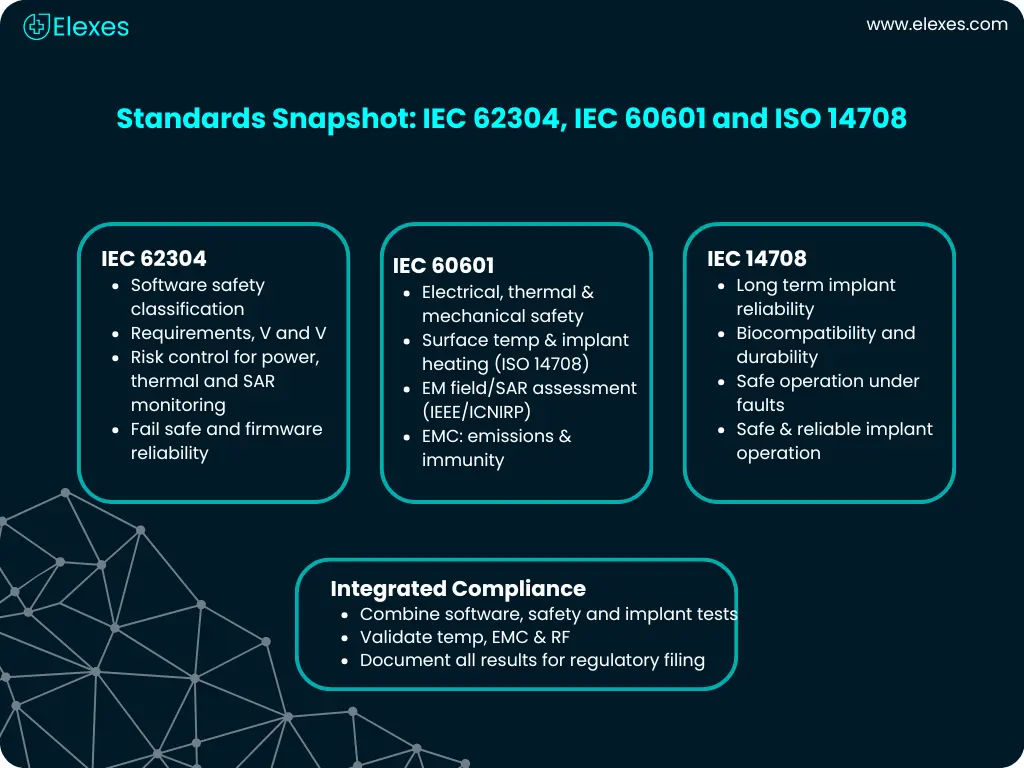
⦿ ISO 14708-1 (+ device-specific parts) for implant safety incl. thermal limits
⦿ ISO 14971 (risk management)
⦿ IEC 60601-1 (general ME requirements) and -1-2 (EMC) for the external Tx
⦿ IEC 62304 (software lifecycle for control firmware/telemetry)
⦿ ISO/TS 10974 for MRI interactions when applicable.
IEC 60601-1 applies only to the external power transmitter or charger, not to the implanted device itself, which instead falls under ISO 14708 and implant-specific sub-parts.
ISO/TS 10974 applies only if the implant is intended to be labeled MR-Safe or MR-Conditional; it is not required for implants without an MRI compatibility claim.
Even though IEC 62304 does not regulate SAR or thermal behavior; instead, it governs how the implant’s control firmware is developed, verified, and validated, especially functions that manage wireless power, prevent overheating, and ensure safe shutdown modes. Control firmware for batteryless implants constantly supervises the wireless power communication, controls the charging, protects against overheating, and implements safe failure modes, all of which must be in accordance with the IEC 62304 standards.
Manufacturers must demonstrate:
⦿ Temperature rise ≤ 2°C under ISO 14708
⦿ Safe operation during fault conditions (open/short coils, misalignment)
⦿ EMC resilience under IEC 60601-1-2
⦿ Software reliability under IEC 62304
⦿ Traceability from hazards → controls → verification
The whole process of validation usually requires a mix of EM simulations, tissue phantom testing, software verification, and risk management documentation.
Summary
The technique of battery-free power transfer using inductive and resonant wireless power transfer can reduce or eliminate the need for surgical battery replacements, improving implant longevity and reducing patient risk. However, achieving safe, efficient performance requires thorough EM simulation, accurate SAR evaluation, and adherence to critical standards such as IEC 62304, IEC 60601, and ISO 14708.
The application of cutting-edge coil designs, high-fidelity modeling, and safety evaluations compliant with regulatory standards can help the next generation of implantable IoT systems to provide a highly reliable, long-term performance with improved patient safety.