
TGA SaMD Regulation in Australia: Is Your Software a Medical Device?
Introduction
The Therapeutic Goods Administration (TGA) has clarified how software-based medical devices are regulated in Australia through its published guidance. The document provides essential details about classification methods and regulatory obligations, yet its actual value lies in supporting strategic decision-making.
The question for digital health, AI, and connected device companies is not just about compliance, but:
Is your software a medical device in Australia, and if so, what does that mean for ARTG inclusion and lifecycle obligations?
Early misunderstanding of this issue will result in launch delays, rework requirements, and unnecessary regulatory risks.
What This Update Is About
The guidance clarifies how the TGA determines whether software qualifies as SaMD (Software as a Medical Device), how it is classified, and when it must be included in the Australian Register of Therapeutic Goods (ARTG).
It addresses:
⦿ When software falls under the Software as medical device regulations
⦿ Risk classification rules for clinical decision support and AI-driven software
⦿ Requirements for ARTG inclusion
⦿ Post-market and lifecycle obligations
Official guidance can be accessed here.
Why This Matters for Digital Health and AI Companies
Australia remains an attractive and growing digital health market. But many companies still question:
⦿ Is software a medical device if it only supports clinicians?
⦿ Is your software a medical device if it uses AI but does not directly diagnose?
⦿ Does wellness positioning exempt you from regulation?
According to the TGA’s SaMD regulations, it is the intended use and clinical effect that matter to the regulatory status, not marketing claims or technical design.
Below are some of the risks:
⦿ Dependence on exemption as a “just software” issue
⦿ Misclassification of risk for AI-enabled devices
⦿ Commercialization before ARTG inclusion
⦿ Underestimating ongoing regulatory maintenance requirements
These risks are not speculative. These can affect timelines, cost models, and market confidence in your product.
What This Means Strategically
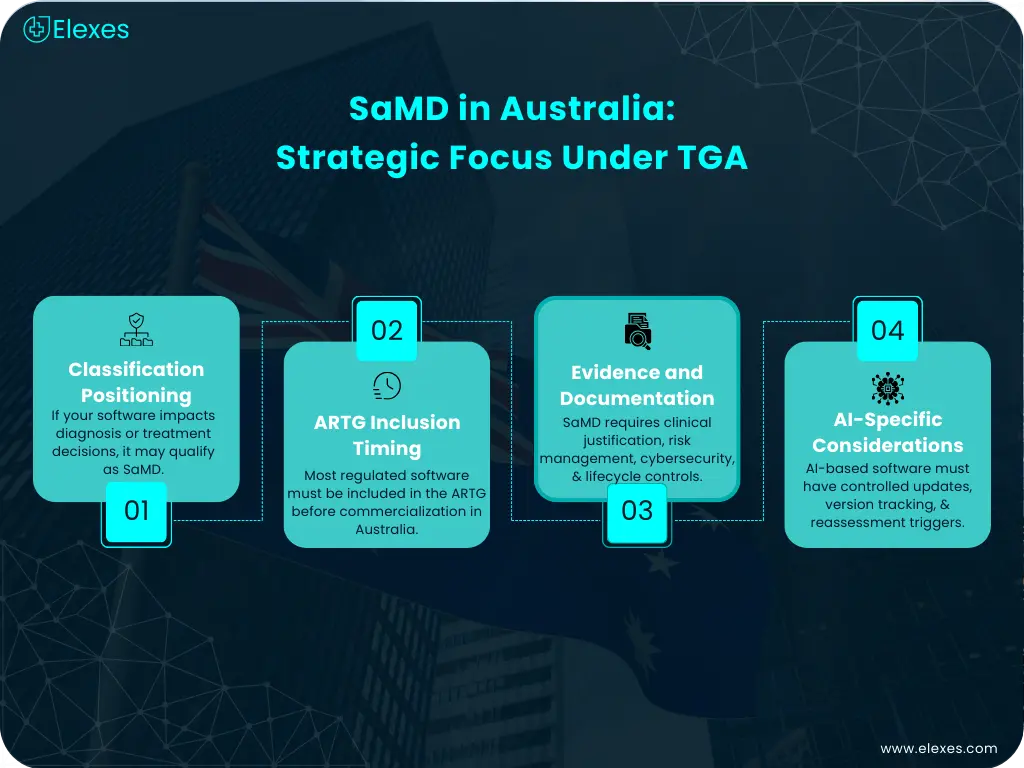
The update should be viewed as a trigger to re-evaluate the following parameters:
Classification Positioning
In Australia, software is classified from Class I to Class III depending on clinical significance and potential harm. Higher classifications require more extensive conformity assessment. If your product influences clinical management, diagnosis, screening, or treatment decisions, it may qualify as SaMD under Australian law.
ARTG Inclusion Timing
Prior to commercialization in Australia, most software will require inclusion in the ARTG, if the software meets the definition of a regulated medical device
Evidence and Documentation
If your product is a SaMD, the TGA will require clinical justification, risk management, cybersecurity, and lifecycle processes.
The scrutiny level will be higher depending on the risk classification. Many software companies undervalue this process.
AI-Specific Considerations
For AI-based tools, change control matters. Regulators will look at how updates are managed, how versions are tracked, and when reassessment is required. Compliance must extend beyond launch.
Where Elexes Fits In

Regulatory positioning at the classification stage determines cost, timelines, and market defensibility, not just compliance. Elexes assists software and AI medical device companies with:
⦿ Formal classification assessment
⦿ Regulatory rationale documentation
⦿ ARTG inclusion strategy and submission support
⦿ Alignment with Software as a Medical Device regulations
⦿ Lifecycle compliance, change management, and audit readiness
For companies entering Australia for the first time, early clarity prevents downstream delays.
You can explore our Australian regulatory support services here.
The latest clarification from the TGA is not just regulatory housekeeping. It is a reminder that software companies entering healthcare must treat regulatory positioning as foundational and not secondary.
If you are undertaking an Australian market entry strategy and are asking, “Is your software a medical device?”, this question should be formally addressed before planning the strategy for market entry.
Considering such strategies will help in reducing costs, improve regulatory defensibility, and might preserve timelines too.
FAQs
-
Does all health software qualify as SaMD in Australia?
No. Only software with a defined medical purpose that meets Australian regulations as a medical device. Wellness-only applications without therapeutic claims are likely exempt.
-
Is ARTG inclusion mandatory before commercialization?
If the software qualifies as a regulated medical device, it must generally be included in the ARTG before being supplied in Australia.
-
How does TGA classify AI-driven software?
Classification depends on the clinical significance of the information provided and the severity of the condition it addresses. Higher clinical impact generally results in higher classification.
-
What if my software is only used for clinical decision support?
If your software influences diagnosis or treatment and is used for clinical decision support only, it will still be considered as SaMD. The level of reliance and the transparency of the logic are considered.
-
Does Australian approval automatically align with EU or FDA pathways?
While there may be similarities, Australian requirements under the TGA software as a medical device rules must be independently assessed.