

FDA Updates Weight-Loss Device Guidance: What It Means for Manufacturers in 2026
The U.S. Food and Drug Administration (FDA) has issued new FDA medical device guidance in March 2026 outlining expectations for medical devices used for weight loss and weight management. This update is a significant step in evolving FDA medical device regulations, particularly for devices targeting obesity, metabolic health, and digital therapeutics.
For companies developing weight loss products approved by FDA, or seeking approval, this guidance provides much-needed clarity and provides clearer expectations for clinical evidence, safety, and regulatory alignment under evolving FDA medical device regulations. The update is particularly relevant for manufacturers evaluating FDA premarket considerations weight loss devices and planning clinical development strategies.
What the Update Covers
The new FDA medical device guidance focuses on three critical areas:
⦿ Clinical Evidence Requirements: Stronger emphasis on clinical evidence demonstrating meaningful and sustained weight loss outcomes
⦿ Premarket Expectations: Detailed FDA premarket considerations weight loss devices, including study design and endpoints
⦿ Labeling and Claims: Clearer expectations for how benefits and risks are communicated to patients
This aligns with broader FDA medical device requirements and evolving FDA medical device regulations to ensure devices are both safe and effective for long-term use.
Who Is Impacted?
This update directly affects companies developing:
⦿ Weight-loss and bariatric devices
⦿ Wearables and digital health platforms targeting obesity
⦿ Metabolic and lifestyle intervention technologies
For these manufacturers, understanding regulatory requirements for weight loss medical devices FDA is now more critical than ever.
Why This Matters?

The updated guidance sets clearer expectations, but they are also more solid:
⦿ Higher Evidence Threshold: The FDA now expects robust FDA clinical evidence expectations weight loss devices, including durability of outcomes
⦿ Increased Scrutiny on Benefit–Risk: Patient safety and long-term effectiveness are central to approval decisions
⦿ Greater Predictability: While stricter, the guidance reduces ambiguity in how to get weight loss device FDA approved
In practical terms, this means companies must integrate regulatory strategy much earlier in product development.
RA/QA Implications for Manufacturers
From a regulatory and quality perspective, companies should:
⦿ Reassess their clinical strategy and endpoints
⦿ Evaluate gaps against updated FDA medical device regulations
⦿ Align documentation with FDA medical device requirements for submission pathways (510(k), De Novo, PMA)
Assess alignment with FDA premarket considerations weight loss devices before initiating clinical studies. Failure to align with FDA medical device requirements may result in additional information requests or longer review timelines.
What Manufacturers Should Review Now
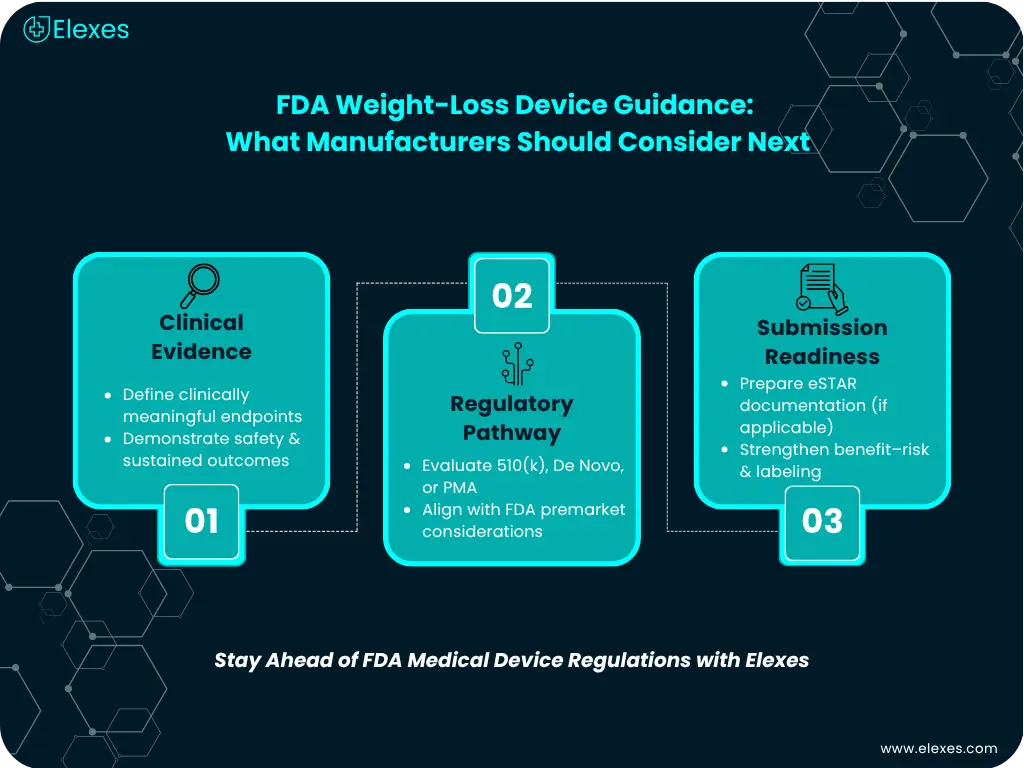
To stay aligned with what manufacturers should know FDA weight loss device guidance, companies should:
⦿ Review current or planned clinical studies against updated expectations
⦿ Revisit regulatory pathways and justification strategies
⦿ Strengthen benefit–risk documentation and patient-centric data
Early alignment will be key to avoiding costly rework.
How Elexes Supports You
At Elexes, we help medical device companies translate evolving FDA medical device guidance into actionable regulatory strategies.
Our support includes:
⦿ Regulatory pathway selection and gap assessments
⦿ Clinical evidence planning aligned with FDA expectations
⦿ eSTAR submission preparation and FDA interaction support
Seeking early alignment can enable manufacturers to speed up their approvals and deliver both safe and effective solutions.
FAQs
What is the latest FDA guidance on weight-loss devices?
The FDA released updated guidance in March 2026 outlining expectations for clinical evidence, labeling, and premarket submissions for weight-loss devices.
Does this change how devices are approved?
No, existing pathways like 510(k), De Novo, and PMA remain the same, but the evidence requirements within these pathways have become more stringent.
What kind of clinical evidence is now required?
Manufacturers must demonstrate meaningful and sustained weight loss, along with safety data and, in some cases, patient-reported outcomes.
Are digital health and wearable devices affected?
Yes, devices targeting weight management, including wearables and software-based solutions, are included under this guidance.
How can companies improve approval chances?
Early alignment with FDA expectations, strong clinical study design, and clear benefit–risk justification are critical.