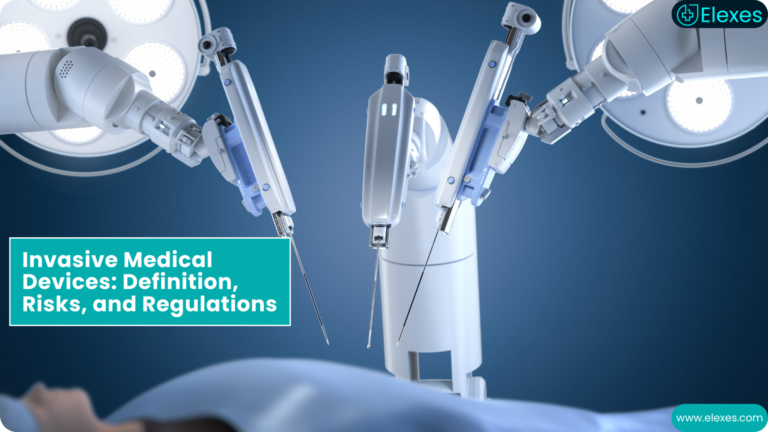
Invasive Medical Devices: Definition, Risks, and Regulations
At Elexes, we have assisted companies that already have FDA clearance for a particular medical device and want to make changes to this existing device to meet their users’ needs, serve a new patient population or simply keep up with the latest technology. A client (Company A) manufacturing non- invasive medical device changed the device’s indications from “in-clinic use/prescription use” to “over-the-counter use” and another client (Company B) manufacturing invasive medical devices expanded the device’s indications for use to include pediatric patients.
As per FDA regulations, every time any changes are made to FDA cleared devices, the changes have to be either recorded internally via the document control and design control processes, or a new submission for approval/clearance of the changes needs to be done. But, whenever “indications for use” are changed, a new submission is mandatory.
Before commencing the creation of all sections of the new submission for Company A (“in-clinic use/prescription use” to “over-the-counter use”) and for Company B (indication for use in pediatric patients), Elexes formulated a thorough regulatory strategy and presented to both the clients. The aim was to adopt the least arduous path and leverage as many learnings as possible from the prior submissions.
Case Example: Changing Indications from Prescription to Over-the-Counter
For Company A, we proposed to perform usability and labeling comprehension studies. This was to demonstrate that the users can easily read the label of the device, understand the intended use of the device, comprehend if it was meant for them, and also correctly use the device, on their own, without any expert or professional help. We created the usability and labeling comprehension study protocols, coordinated with the test coordinator, facilitated subject recruitment, and finally based on datasheets, formulated the test reports. Traditional 510(k) with usability and labeling comprehension study results were submitted to the FDA.
Case Example: Expanding Use to Pediatric Population
For Company B, we proposed to leverage post-marketing data (retrieved from the FDA MAUDE and internal complaint handling system and
non-conformance material board) to demonstrate the safety and effectiveness of this particular device in the adult population and extrapolated some of this data for the pediatric population. Additionally, we conducted a thorough literature review and created a clinical evaluation report about the use of a similar device in the pediatric population. 21 sections of 510(k) submissions, including an updated user manual and shipping labels to reflect the new indications and test results, to support the new indications were submitted to the FDA.
After the new submissions were cleared by the FDA, Company A was immediately able to import its device with the new indications and Company B was able to sell their devices to their new target population.
All in all, Elexes provided practical solutions tailored to the clients’ specific needs.
Need Help With Invasive Medical Device Classification?
FAQs
What is an invasive medical device – definition under EU MDR and global context?
An invasive medical device is one intended to penetrate the body through a body orifice or through the surface of the body, either wholly or in part, as designed by the manufacturer.
Which classification rules apply to invasive medical devices (Rules 5-8) and what do they mean?
Under EU MDR Annex VIII, Rules 5-8 classify invasive devices based on how they enter the body (through body orifices or surgical penetration) and duration of use, determining whether they fall into Class I, IIa, IIb or III risk categories.
What regulatory and submission requirements apply specifically to invasive devices compared to non-invasive devices?
Invasive devices often require a higher risk classification, involvement of a Notified Body (for EU), more extensive technical documentation, and stronger clinical evidence than non-invasive devices.
What are common compliance gaps in invasive medical devices and how can manufacturers avoid them?
Common gaps include incorrect classification, insufficient clinical evidence, and weak post-market surveillance. Manufacturers can avoid these by performing robust classification checks, conducting strong clinical evaluation, and implementing proactive PMS planning.
How do regulatory requirements differ across regions (EU vs US vs Australia) for invasive devices?
In the EU, invasive devices follow MDR risk classifications and Notified Body review. In the US, the FDA uses Class I-III with 510(k)/PMA pathways. In Australia, the TGA classifies devices based on risk and Essential Principles compliance, with an ARTG listing.