
FAQs on ISO 15223-1:2021 and Medical Device Symbols
As we all know that symbols play a very important part in medical device labeling, hence it is critical to know when the relevant standard undergoes changes. If you are a medical device manufacturer or Innovator and want to know more about the latest version of the ISO 15223-1:2021, then, this article is for you!
The ISO 15223-1 standard details the symbols to be present on the Medical Device label and it is recommended for Medical Device manufacturers to be in compliance with this standard and the country specific regulations and labeling requirements to sell devices in different worldwide markets seamlessly without any non-conformance. Let us have a look at the list of common questions that are being asked by the Medical Device manufacturers on the latest version (2021) of the ISO 15223-1 standard which was earlier in the 2016 version.
Elexes ensures CE/FDA labeling accuracy with ISO 15223‑1 expertise, over 150 devices labeled correctly. Labeling non-compliance risks not only inspection failure but recalls RA and QA Directors must apply these symbols accurately.
What is the transition deadline for ISO 15223-1:2021?
The transition period varies based on the relevant regulatory market.
ISO 15223-1:2021 (including Amendment 1:2025) is accepted by the FDA. The FDA will accept the declaration of conformity to the recognized 2021 version up to December 17, 2028.
In the case of EU, manufacturers need to ensure the applicable harmonized standard references and labeling under MDR/IVDR.
Is the “MD” symbol mandatory to be present on the label ?
As per Annex I of the EU MDR regulation, manufacturers have to indicate on the device label that the product is a medical device. Hence the “MD” symbol will be of great help for someone selling their products in the EU and other jurisdictions that recognize CE marking. Further, inserting an “MD” symbol is far easier than mentioning ‘medical device’ on the label as in the latter case, the manufacturer has to translate the label into many languages based on the EU jurisdictions in which the device is to be sold.
The ISO 15223-1:2021 version includes a “UDI” symbol. Is it needed to be put along with the UDI carrier on the Label ?
This depends on the medical device manufacturer’s label. If the label contains more than one QR Code or bar code and it is difficult to tell which one is a UDI carrier then it will be better that the manufacturer uses the “UDI” symbol, besides the UDI carrier, for easier identification. Additionally, it depends on the regulatory authority whether they make it mandatory to use the “UDI” symbol.
What about the inclusion of the “Translation” symbol in the list of symbols within the IFU ?
The translation symbol shall be added to the manufacturer’s IFU only when the translated information is not controlled by the manufacturer i.e the translation activity is being outsourced to a sub-contractor. The name and address of the sub-contractor performing translation shall also be added on the manufacturer’s label along with the “translation” symbol. The translation symbol was introduced in the ISO 15223-1:2021 version in order for EU importers and distributors to be in compliance with Article 16 of the MDR.
Is a Change Notification required to be submitted to the EU Notified Body for making changes to the Label ?
All label modifications may not need to be notified to the EU Notified Body. Whether this is necessary or not will depend on what the modification entails and how it impacts the intended use and safety/quality performance of the device.
In relation to legacy devices which fall under the transition rules of the MDR, the MDCG 2020-3 Rev. 1 gives guidelines on how to assess major changes in the design and intended purpose of the product.
Shall we wait for the EU to release the list of harmonized standards so as to start with the MDR/IVDR remediation process ?
We advise all the medical device manufactures not to wait for the EU to release the list of harmonized standards and start performing a gap analysis of the newly released standards so as to start complying with the latest requirements since the EU journal gets revised only a few times per year, while the standards can get updated at a faster rate and it is important to give yourselves ample of time to make the necessary updates such that there is no impact on the regular business and commercialization or sales of medical devices in the impacted markets.
Concerned about performing Gap Analysis and unsure how to plan a transition?
Don’t worry! Elexes team is here to help you. Our dedicated team has years of experience performing gap analysis and helping to be in compliance with the newly released version of the medical device standards. Please contact us via email [email protected] or call +1 650-503-6615 for further details.
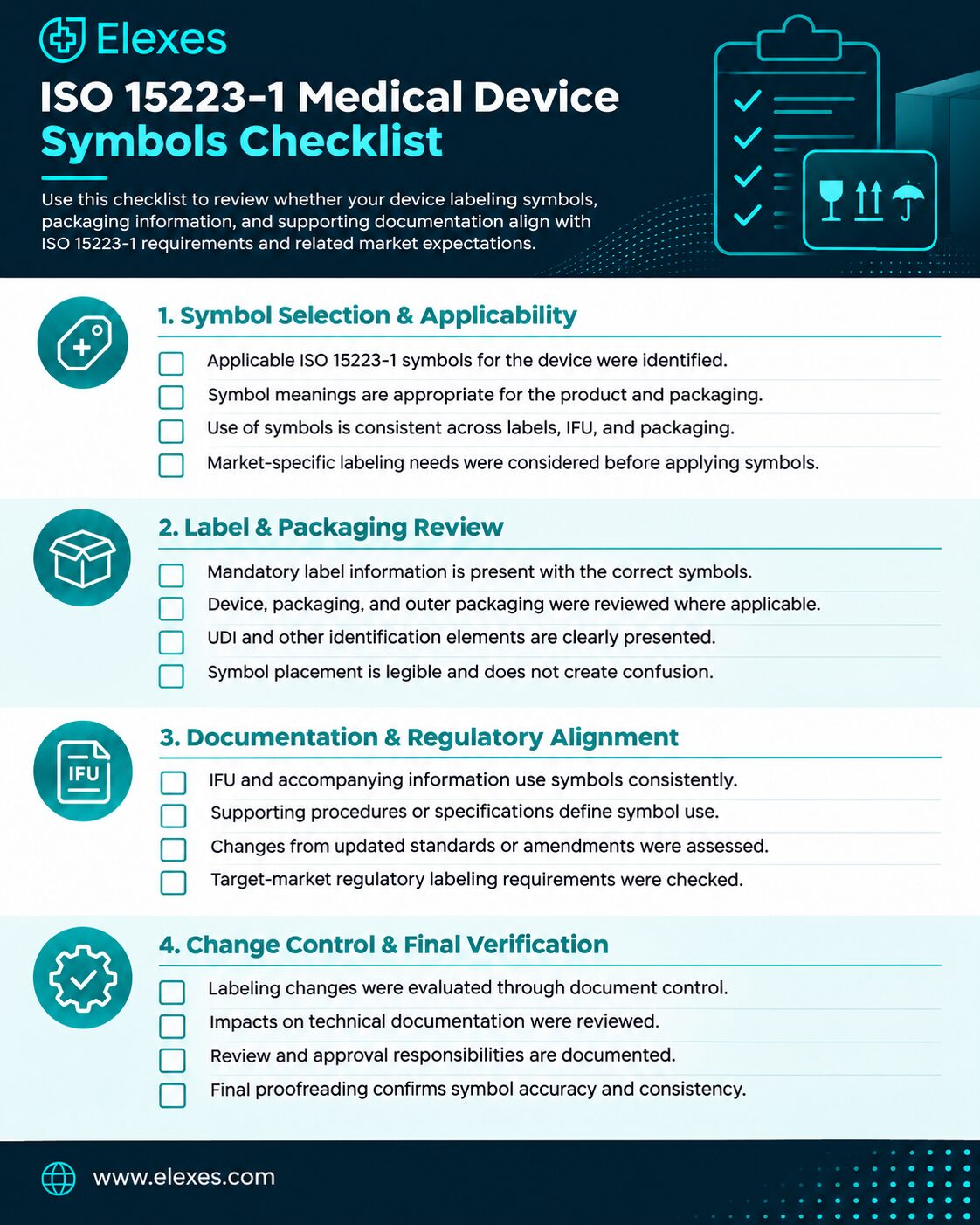
Review your medical device labeling symbols with confidence.
Download the ISO 15223-1 checklist
Request a Labeling Compliance Review
FAQs
What is ISO 15223-1:2021?
ISO 15223-1:2021 is an international standard that defines the symbols to be used in medical device labeling to ensure consistent understanding across regions.
What symbols are required under EU MDR?
Under the EU MDR, manufacturers must ensure that device labeling includes the necessary symbols required under Annex I such as sterile packaging, single-use devices etc, and applicable to the device in question. The CE marking is required under EU legislation but is not defined by ISO 15223-1.
Are ISO 15223-1 symbols accepted by the FDA?
Yes, the FDA recognizes ISO 15223-1:2021 standard for medical device labeling in the United States.
What’s new in ISO 15223-1:2021?
The 2021 revision introduced new symbols that are aligned for EU MDR compliance. The 2021 update expanded the set of safety-related symbols to address and align closely with evolving regulatory and user needs.
Where should symbols be used — on device, packaging, or IFU?
Symbols may appear on the device, its labelling, outer packaging, and/or Instructions for Use depending on the nature of the device and applicable regulations.